What Schema Conversion Will Not Rewrite
Quick summary: DMS Schema Conversion sorts objects into converted, warnings, and will-not-convert. The project is the last bucket plus the SQL that lives in the ORM. A connection-string change is not that backlog.
Key Takeaways
- On 4 October 2026 the useful unit is the assessment itself: DMS Schema Conversion, not the older Schema Conversion Tool name
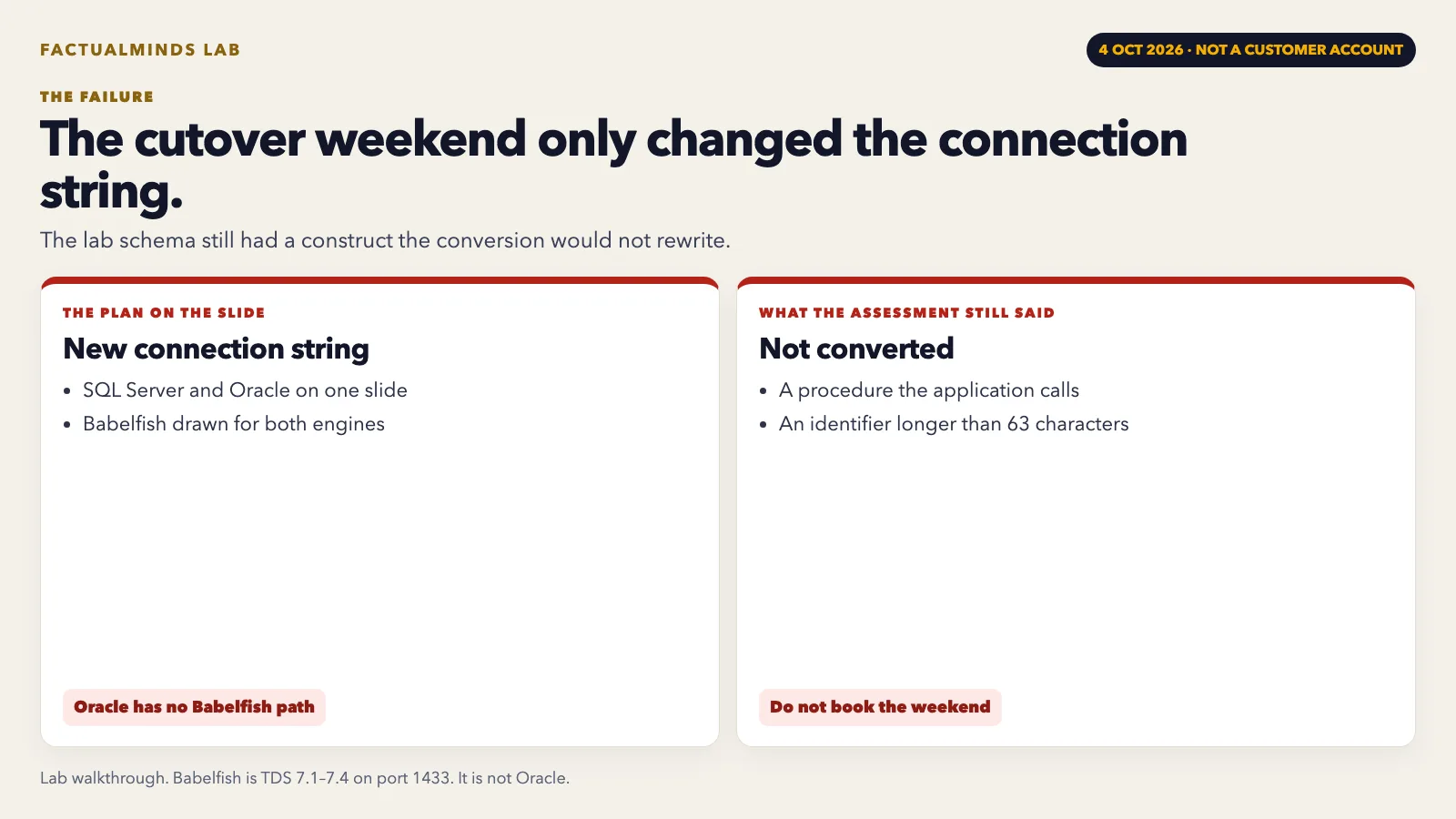
- Where this fails > What broke: Lab, 4 October 2026
- What to do this week 1
- 2
- 3
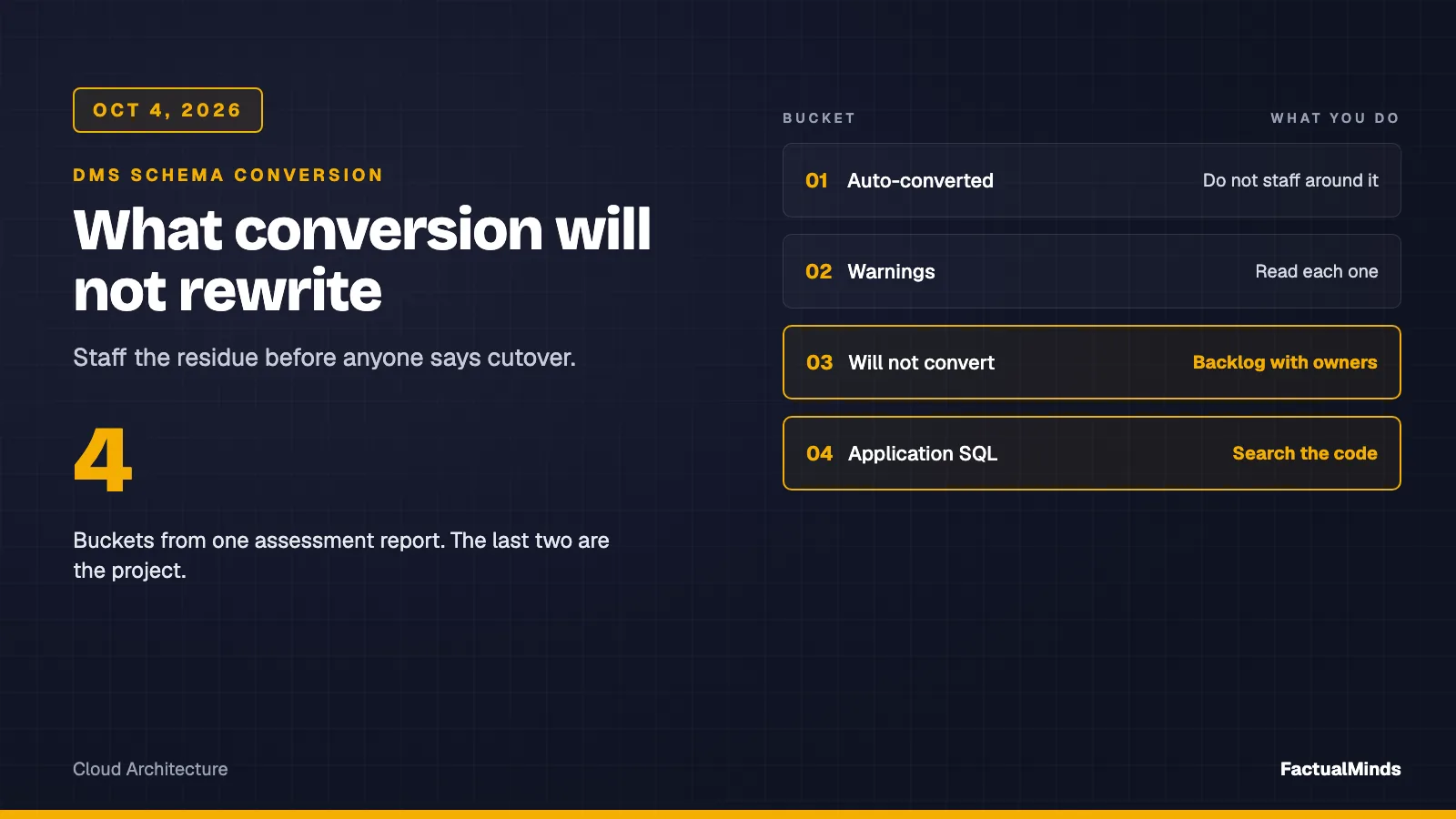
Table of Contents
The DMS playbook tells you to run an assessment and then says it does not cover ORM rewrites beyond what that assessment flags. The refactor post’s database pattern is still easy to misread as a connection-string change. On 4 October 2026 the useful unit is the assessment itself: DMS Schema Conversion, not the older Schema Conversion Tool name.
The Oracle and SQL Server decision owns the fork: stay licensed, Babelfish, or convert. This page starts only after convert is the choice. Babelfish is partial T-SQL. It is not a zero-rewrite promise, and it is not this backlog.
Four buckets
| Bucket | What it is | What you do |
|---|---|---|
| Auto-converted | Objects the assessment converts cleanly | Do not staff a project around this count. |
| Warnings | Converted with a behavior you have not accepted | Read them. A warning is not a percentage. |
| Will not convert | Procedures, triggers, jobs, and types the tool refuses | This is a backlog with owners. |
| Application SQL | Statements in the ORM or the service, invisible to the database assessment | Search the code. The assessment will not list them. |
We recommend staffing the third and fourth buckets before cutover. The trade-off is a longer project than the row-count demo. A weekend cutover that moves tables and leaves procedures behind is how the application fails on Monday with the data already on Aurora PostgreSQL.
Where this fails
What to do this week
- Open the latest DMS Schema Conversion assessment. Fill the four counts.
- Turn will-not-convert into tickets. Do not average them into a percent complete.
- Search the application for vendor SQL the assessment cannot see.
- Leave task settings, LOB lag, and the cutover checklist on the DMS playbook.
- If the residue is the engagement, talk to RDS consulting.
What this post doesn’t cover
It does not choose Babelfish versus convert, design Aurora Limitless, or walk DMS task settings. It does not claim a percentage of objects that convert. That number is whatever your assessment says.
Frequently asked questions
Why does the application fail after DMS moves the data?
When should we not schedule cutover?
What could go wrong if we treat warnings as noise?
Is this the Oracle and SQL Server decision?
Should we still say Schema Conversion Tool?

AWS Cloud Architect & AI Expert
AWS-certified cloud architect and AI expert with deep expertise in cloud migrations, cost optimization, and generative AI on AWS.